
The rapid growth of online earning apps has sparked serious questions among users in Pakistan, especially regarding their religious permissibility. One of the most frequently discussed platforms is the 666D Game. Many people are curious whether participating in such apps aligns with Islamic principles or falls into prohibited territory. This article explores the topic in detail, examining it through both Islamic teachings and the legal environment of Pakistan.
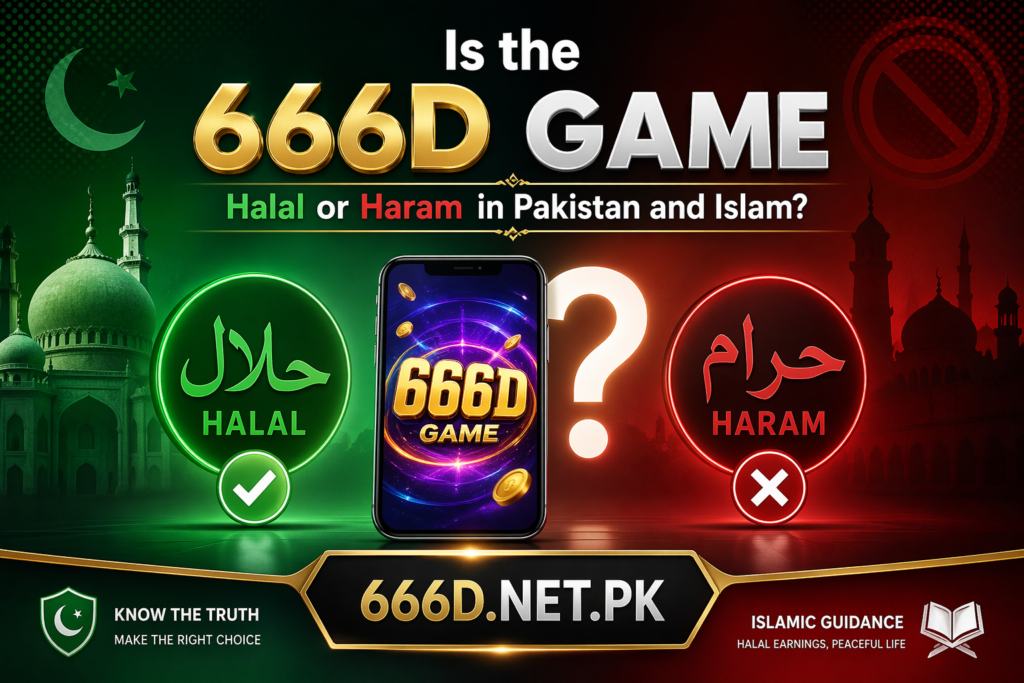
Understanding how the 666D Game works?
Before reaching any conclusion, it’s essential to understand how the 666D Game Pakistan works. Platforms like this typically involve users depositing money and earning profits through predictions, spins, or chance-based activities. While they may appear as simple entertainment or earning tools, their structure often resembles betting systems. The core mechanism usually depends on uncertain outcomes rather than guaranteed returns.
Islamic Perspective on Earning Methods
Islam places strong emphasis on halal (permissible) income and clearly prohibits haram (forbidden) earnings. Any form of income that involves deception, uncertainty, or unjust gain is discouraged. The concept of gharar (excessive uncertainty) and maisir (gambling) plays a central role here. If an activity depends purely on luck and one person’s gain comes at another’s loss, it generally falls under prohibited categories.
Does the 666D Game Involve Gambling?
A critical factor in determining permissibility is whether the platform operates on gambling principles. If users are required to invest money with the hope of earning more based on unpredictable results, it aligns closely with gambling. In such cases, profits are not generated through effort, skill, or legitimate trade but through chance. This structure strongly resembles maisir, which is explicitly forbidden in Islam.
The Role of Risk and Uncertainty
Islam does not prohibit risk entirely; business itself involves some level of uncertainty. However, there is a clear difference between calculated risk in trade and blind risk in gambling. In the 666D Game, outcomes are often not based on user expertise but on random systems. This level of unpredictability raises concerns under Islamic law, making it difficult to classify such earnings as lawful.
Legal Status in Pakistan
Apart from religious considerations, Pakistani law also plays a role. Many online betting or gambling platforms operate in a grey or restricted area. Authorities in Pakistan have taken action against similar applications due to concerns over fraud, financial loss, and illegal activity. Even if a platform is accessible, it does not necessarily mean it is legally approved.
Financial and Ethical Concerns
Beyond legality and religion, there are practical risks involved. Many users report losses rather than profits, and the system often benefits the platform owners more than participants. This imbalance raises ethical questions, as wealth is being transferred without fair exchange or productive effort. Islam promotes justice and fairness in financial dealings, which such systems may fail to uphold.
Scholarly Opinions
Most Islamic scholars agree that any earning method resembling gambling is haram. If a platform requires staking money with uncertain returns based on luck, it is generally classified as impermissible. Scholars consistently advise Muslims to avoid doubtful sources of income and choose clear, ethical earning methods instead.
Safer Alternatives for Earning
For those looking to earn online, there are many halal alternatives available. Freelancing, digital services, e-commerce, and skill-based work provide legitimate income opportunities. These methods involve effort, transparency, and fair exchange, aligning with Islamic teachings and reducing financial risk.
Conclusion
Choosing halal income is not only a religious obligation but also a path toward long-term stability and peace of mind. While apps like the 666D Game may seem attractive due to quick earning promises, they carry significant risks and ethical issues. It is always better to pursue income sources that are transparent, lawful, and aligned with Islamic values.